



Army Commanders’ Conference 2025: Strategic Vision and Technological Advancement for National Security
“The Indian Army plays a pivotal role in securing our borders, combating terrorism, and offering assistance to civil authorities during crises,” the Raksha Mantri remarked.
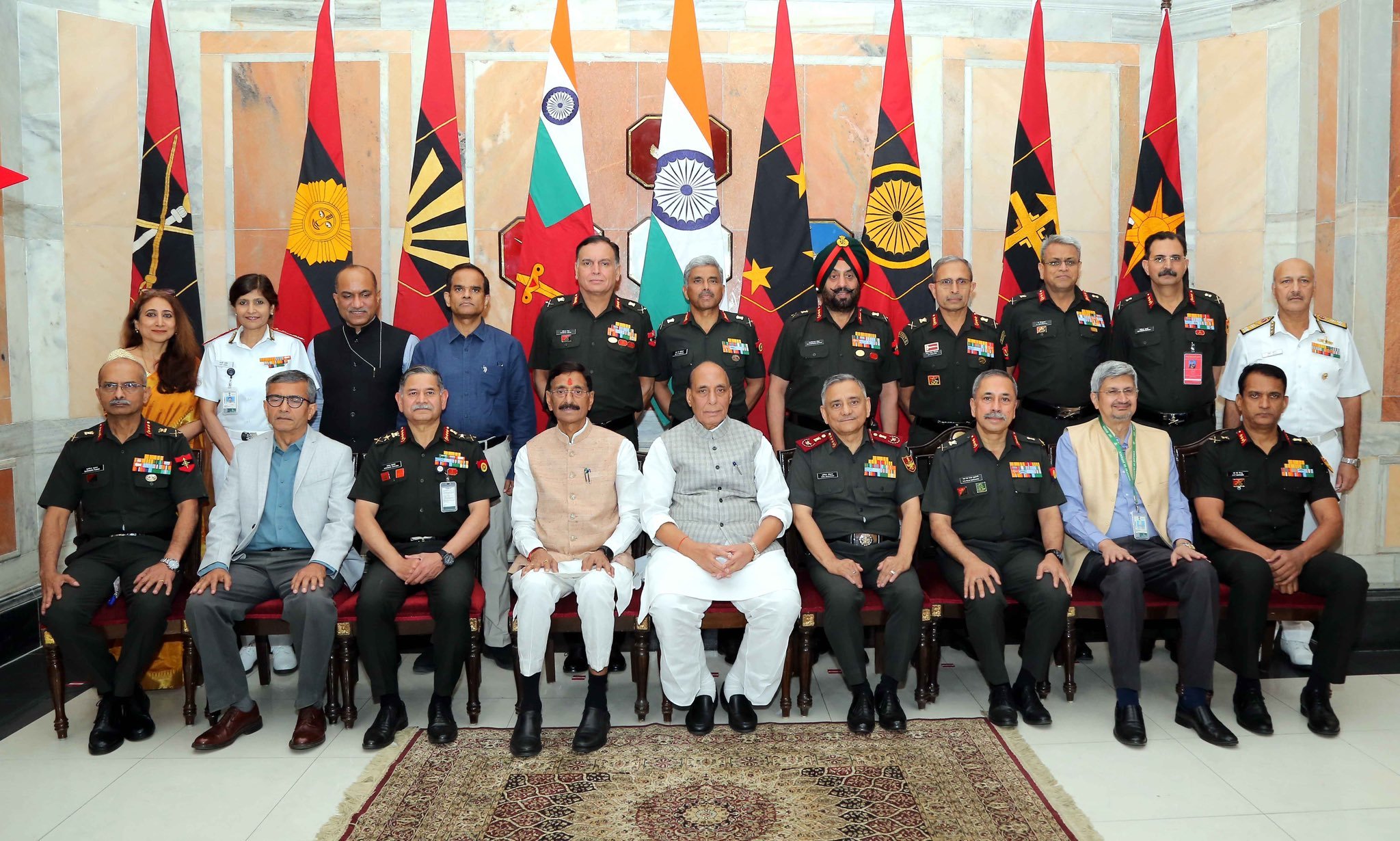
- Country:
- India
The 2025 Army Commanders’ Conference, a pivotal biannual event, is being held in New Delhi from April 1 to April 4. This conference serves as an apex platform for the Indian Army's senior leadership to engage in comprehensive deliberations on a wide range of critical topics, encompassing both the existing security scenarios and challenges posed by the global geopolitical landscape. The discussions also included reviews of military readiness, logistics, human resource management, organisational restructuring, and modernization of armed forces through indigenisation and niche technologies.
Raksha Mantri’s Address: Vision for Security and Modernisation
On the third day of the conference, the Hon’ble Raksha Mantri, Shri Rajnath Singh, delivered a keynote address to the senior leadership of the Indian Army, following a detailed brief on the ‘Year of Reforms’. His speech highlighted the Indian Army's significant role in ensuring national security, stability, and development, both on the borders and within the country. The Raksha Mantri reaffirmed the immense trust the Indian populace places in the Army, calling it one of the most revered and inspiring institutions in the nation.
“The Indian Army plays a pivotal role in securing our borders, combating terrorism, and offering assistance to civil authorities during crises,” the Raksha Mantri remarked. He commended the Army's contributions across diverse domains, including humanitarian assistance and disaster relief (HADR), medical support, and maintaining internal stability. He further stated that the Army’s involvement in nation-building and national development is integral to the country’s progress.
Shri Rajnath Singh also praised the Army's commitment to adopting cutting-edge technologies and innovations to strengthen its operational capabilities. The Raksha Mantri emphasized the critical need for the armed forces to incorporate emerging technologies, particularly in the areas of cyber warfare, information systems, and communication.
Addressing the Geo-Strategic Landscape
A significant portion of the Raksha Mantri's address focused on the evolving global security environment and the challenges it presents. He expressed concerns over the uncertainties in the geo-strategic landscape and the interconnectedness of the modern world. "The current world order is highly interdependent, and any crisis, whether occurring in our neighborhood or far-off regions, has global implications,” he remarked.
He underscored that the future of warfare would involve unconventional and asymmetric methods, including hybrid warfare, cyber-attacks, and information warfare. These elements, he explained, are now inseparable from the fabric of modern conflicts. He highlighted the necessity for the Armed Forces to prepare strategies that account for these multifaceted threats and challenges.
“In the face of such evolving threats, it is essential for the armed forces to adapt, with a dynamic perspective that includes both long-term and short-term planning. This will ensure that we remain prepared to counter any emerging security challenge,” he stated.
The Raksha Mantri further stressed the increasing importance of military intelligence in navigating these complex threats. Leveraging advanced technologies in military intelligence, he noted, would be critical in ensuring that the Indian Army stays ahead of adversaries.
Border Security and the Role of BRO
The Raksha Mantri also addressed the current situation along India’s northern and western borders, commending the Indian Army's vigilance and the robust defensive posture along these areas. With regard to the northern borders, he expressed full confidence in the armed forces and emphasized the need for continued preparedness and vigilance. “The troops have displayed remarkable resilience and determination in securing our borders. This stance must remain steadfast,” he stated.
He specifically praised the Border Roads Organisation (BRO) for its remarkable work in improving infrastructure in the border areas, particularly in the northern and western regions, under challenging conditions. This infrastructure development, he noted, plays a crucial role in enhancing the Army’s operational capabilities and connectivity in strategic regions.
Tackling Cross-Border Terrorism
On the western borders, the Raksha Mantri acknowledged the Indian Army’s successful efforts in responding to cross-border terrorism, although he pointed out that the threat of proxy wars from adversaries continues to be a serious challenge. He particularly highlighted the importance of the synergy between the Army, Central Armed Police Forces (CAPF), and local police forces in combating terrorism in Jammu and Kashmir.
“The coordinated efforts between various security agencies have contributed significantly to stabilizing the region. This cooperation must continue, as it is crucial for ensuring long-term peace and security in the Union Territory,” he remarked.
Operational Preparedness and Modernisation
During his address, Shri Rajnath Singh also complimented the Army’s high standards of operational preparedness, emphasizing that the Army’s capabilities remain at an exceptional level, which he has personally observed during his visits to forward areas. The Raksha Mantri also paid tribute to the soldiers who have made the ultimate sacrifice in defense of the nation, recognizing their bravery and dedication to the country.
The Hon’ble Raksha Mantri expressed his appreciation for the Indian Army’s growing efforts in military diplomacy, which is crucial for fostering strong defense partnerships with foreign armies. This, he said, has played a significant role in advancing national security interests globally.
Moreover, the Raksha Mantri reiterated the importance of integrating technological advancements across various aspects of military operations. He applauded the Indian Army's initiatives to develop niche technologies in collaboration with civil industries, premier educational institutions, and defense research agencies. This aligns with the goal of ‘Modernisation through Indigenisation’ or 'Atmanirbhar Bharat,' which aims to reduce dependence on foreign imports for defense technology.
Emphasis on Defence Diplomacy and Future-readiness
One of the key highlights of the conference was the Raksha Mantri’s call for the Armed Forces to continually reassess and realign their strategies in accordance with emerging global realities. He stressed that the areas of defense diplomacy, indigenisation, information warfare, defense infrastructure, and force modernization should be continuously discussed and reviewed in forums like the Army Commanders’ Conference.
"Doctrinal changes should be made whenever necessary to ensure that the Armed Forces are always prepared for the future,” the Raksha Mantri said, emphasizing that the leadership must not only deliberate on issues but also ensure that actionable outcomes are derived from such deliberations. He urged that recommendations and suggestions from the senior leadership be reviewed regularly for midcourse adjustments to stay aligned with evolving security needs.
In his closing remarks, Shri Rajnath Singh reiterated the government’s unwavering commitment to the welfare of the armed forces, especially veterans and the families of battle casualties. He also acknowledged the sacrifices made by the soldiers and their families, emphasizing that the nation remains forever indebted to their courage and service.
"The nation is immensely proud of its Army, and the Government is committed to supporting the Army in its continuous journey toward reforms and capability enhancement," he concluded.
The Army Commanders' Conference has proved to be an essential platform for fostering discussions on strategic military matters and ensuring that the Indian Army remains prepared for the future, both in terms of operational readiness and technological advancements. As the world continues to change, the Indian Army’s leadership is resolutely focused on strengthening its capabilities to meet new-age security challenges.
- READ MORE ON:
- Army Commanders’ Conference
- Rajnath Singh


 Google News